

WEIGHT CALCULATOR
HEA beam weight chart
Choose a wide-flange HEA beam and enter length and quantity to get its weight. Dimensions and a kg/m chart for HEA 100–1000 follow below.
Material selection
A general estimate for this material. Selecting a grade can provide a more specific density.
Custom density
Dimensions and quantity
Other: HEA
Leave empty to calculate weight only. The price is used for this calculation alone; no currency conversion is applied. Request a current price
HEA 200: h 190 · b 200 · tw 6.5 · tf 10 · r 18 mm · A 53.8 cm²
How is the weight calculated?
The section area is multiplied by density to find kg/m. Piece weight uses the entered length; total weight also includes quantity.
catalogue mass (kg/m, carbon steel 7.85 g/cm³) × density ÷ 7.85 = kg/m
kg/m × length (mm) / 1000 × quantity = total kg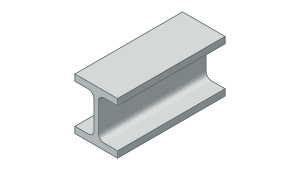
Carbon / structural steel
- Weight per metre
- 42.3 kg/m
- Weight per piece
- 253.8 kg
- Density used
- 7.85 g/cm³
A theoretical estimate. Actual dimensions, tolerances and material properties can change the measured weight.
HEA beam weight chart
Dimensions and carbon steel mass from the producer’s catalogue (EN 10365 dimensions; IPN DIN 1025-1, UPN DIN 1026-1). Actual bars vary within the rolling tolerances.
HEA weight chart and dimensionsHEA 100–1000 · carbon steel · h, b, tw, tf, r in mm · A cm² · kg/m, 6 m, 12 m
| Section | h | b | tw | tf | r | A (cm²) | kg/m | 6 m (kg) | 12 m (kg) |
|---|---|---|---|---|---|---|---|---|---|
| HEA 100 | 96.0 | 100.0 | 5.0 | 8.0 | 12.0 | 21.2 | 16.7 | 100.2 | 200.4 |
| HEA 120 | 114.0 | 120.0 | 5.0 | 8.0 | 12.0 | 25.3 | 19.9 | 119.4 | 238.8 |
| HEA 140 | 133.0 | 140.0 | 5.5 | 8.5 | 12.0 | 31.4 | 24.7 | 148.2 | 296.4 |
| HEA 160 | 152.0 | 160.0 | 6.0 | 9.0 | 15.0 | 38.8 | 30.4 | 182.4 | 364.8 |
| HEA 180 | 171.0 | 180.0 | 6.0 | 9.5 | 15.0 | 45.3 | 35.5 | 213.0 | 426.0 |
| HEA 200 | 190.0 | 200.0 | 6.5 | 10.0 | 18.0 | 53.8 | 42.3 | 253.8 | 507.6 |
| HEA 220 | 210.0 | 220.0 | 7.0 | 11.0 | 18.0 | 64.3 | 50.5 | 303.0 | 606.0 |
| HEA 240 | 230.0 | 240.0 | 7.5 | 12.0 | 21.0 | 76.8 | 60.3 | 361.8 | 723.6 |
| HEA 260 | 250.0 | 260.0 | 7.5 | 12.5 | 24.0 | 86.8 | 68.2 | 409.2 | 818.4 |
| HEA 280 | 270.0 | 280.0 | 8.0 | 13.0 | 24.0 | 97.3 | 76.4 | 458.4 | 916.8 |
| HEA 300 | 290.0 | 300.0 | 8.5 | 14.0 | 27.0 | 112.5 | 88.3 | 529.8 | 1059.6 |
| HEA 320 | 310.0 | 300.0 | 9.0 | 15.5 | 27.0 | 124.4 | 97.6 | 585.6 | 1171.2 |
| HEA 340 | 330.0 | 300.0 | 9.5 | 16.5 | 27.0 | 133.5 | 105.0 | 630.0 | 1260.0 |
| HEA 360 | 350.0 | 300.0 | 10.0 | 17.5 | 27.0 | 142.8 | 112.0 | 672.0 | 1344.0 |
| HEA 400 | 390.0 | 300.0 | 11.0 | 19.0 | 27.0 | 159.0 | 125.0 | 750.0 | 1500.0 |
| HEA 450 | 440.0 | 300.0 | 11.5 | 21.0 | 27.0 | 178.0 | 140.0 | 840.0 | 1680.0 |
| HEA 500 | 490.0 | 300.0 | 12.0 | 23.0 | 27.0 | 197.5 | 155.0 | 930.0 | 1860.0 |
| HEA 550 | 540.0 | 300.0 | 12.5 | 24.0 | 27.0 | 211.8 | 166.0 | 996.0 | 1992.0 |
| HEA 600 | 590.0 | 300.0 | 13.0 | 25.0 | 27.0 | 226.5 | 178.0 | 1068.0 | 2136.0 |
| HEA 650 | 640.0 | 300.0 | 13.5 | 26.0 | 27.0 | 241.6 | 190.0 | 1140.0 | 2280.0 |
| HEA 700 | 690.0 | 300.0 | 14.5 | 27.0 | 27.0 | 260.5 | 204.0 | 1224.0 | 2448.0 |
| HEA 800 | 790.0 | 300.0 | 15.0 | 28.0 | 30.0 | 285.8 | 224.0 | 1344.0 | 2688.0 |
| HEA 900 | 890.0 | 300.0 | 16.0 | 30.0 | 30.0 | 320.5 | 252.0 | 1512.0 | 3024.0 |
| HEA 1000 | 990.0 | 300.0 | 16.5 | 31.0 | 30.0 | 346.8 | 272.0 | 1632.0 | 3264.0 |
Worked example
- HEA 200, 4 lengths of 6 m: 53.8 cm² × 0,785 = 42.3 kg/m; × 6 m × 4 = 1015.2 kg.
What is an HEA beam?
HEA is the European wide-flange H section, dimensioned in EN 10365 (formerly DIN 1025-3). Up to size 300 an HEA is slightly less deep than it is wide: HEA 200 is 190 mm deep and 200 mm wide. It is used for columns, heavy beams, crane rails and machine bases.
Unit weight and cross-section
For hot-rolled sections the unit weight is area × 7.85 ÷ 10 (area in cm², result in kg/m). For HEA 200: 53.8 cm² × 0.785 = 42.23 kg/m, matching the catalogue’s 42.3 kg/m. The area adds up web, flanges and root fillets, which is why section weight comes from the tabulated area rather than a simple rectangle formula.
HEA versus HEB
At the same nominal size HEB is clearly heavier than HEA: at 200, HEA is 42.3 kg/m and HEB 61.3 kg/m; at 300, HEA is 88.3 kg/m and HEB 117.0 kg/m. The difference comes from thicker flanges and web; the choice follows the structural calculation.
Frequently asked questions
How much does HEA 200 weigh per metre?
HEA 200 weighs 42.3 kg/m, so a 6 m length is 253.8 kg and a 12 m length 507.6 kg. Its area is 53.8 cm².
How much does HEA 160 weigh per metre?
HEA 160 weighs 30.4 kg/m, so a 6 m length is 182.4 kg and a 12 m length 364.8 kg. Its area is 38.8 cm².
How much does HEA 180 weigh per metre?
HEA 180 weighs 35.5 kg/m, so a 6 m length is 213.0 kg and a 12 m length 426.0 kg. Its area is 45.3 cm².
How much does HEA 240 weigh per metre?
HEA 240 weighs 60.3 kg/m, so a 6 m length is 361.8 kg and a 12 m length 723.6 kg. Its area is 76.8 cm².
How much does HEA 300 weigh per metre?
HEA 300 weighs 88.3 kg/m, so a 6 m length is 529.8 kg and a 12 m length 1059.6 kg. Its area is 112.5 cm².
How do I read the HEA beam weight chart?
Each row is one section size. h is the height, b the flange width, tw the web and tf the flange thickness, r the root radius (mm) and A the area (cm²). The kg/m column is the carbon steel weight per metre; the 6 m and 12 m columns give the weight of one length.
How do I calculate HEA price from weight?
Find the piece weight first, then multiply by the unit price: piece weight × price per kg, or length (m) × price per metre. If you have a price per tonne, divide it by 1000 to get the price per kg. Enter the price in the calculator’s optional “Unit price” field and choose its unit to see the amount per piece and in total next to the weight; leave it empty to calculate weight only.